
USER RESEARCh • requirements gathering • end-to-end product design • deep domain
overview
BosonQ Psi is a deep tech company specializing in building simulation software built on top of quantum-inspired optimization algorithms (QIEO) that run much faster than traditional software.
Likewise, an optimized model for aircraft crew assignment had been developed. My role as a Product Design intern was to translate this engine into a user-centric interface during a 16-week sprint.
I worked along a team of 3 application developers, and the software team to design an interface that translated a heavy constraints based system to an intuitive UI for future aviation planners.
design sketches
Before moving into high-fidelity designs, I did a deep dive into domain & used sketching to map out the core logic of the optimization interface. These early explorations focused on how to translate complex algorithmic outputs into a human-readable format.
// 01
main data structure


// 02
violations & edge cases
// 03
exploring manipulation freedom

// early discovery
Open Questions i Explored
Early discovery surfaced questions that shaped the design direction. These came from cross-functional discussions with application developers.
what is the output of the optimizer?
What is the structure and granularity of the optimizer’s output?
allow the user to edit the output?
Should we allow users to edit within the execution view after the optimizer has run?
allow manual overrides by user?
My idea was to let planners lock a service to a crew member and re-run the optimizer around; as well as allowing users to adjust constraints using sliders letting them steer the optimizer towards outputs with different tradeoffs.
does the optimizer produce violations?
What type of violations does the optimizer produce, if any? How should the user proceed forth in case of violations?
What We Cut & Why
These features generated significant design exploration but were ultimately scoped out of the V1 release. The decisions were influenced by product strategy & current development constraints rather than user needs, each feature remains on the roadmap for future releases.
// problem framing
design goal
Provide planners a clear picture of what the optimizer produced, surface violations immediately, and provide information to fix & re-run while simultaneously avoiding data that adds noise without actionability in V1 release.
// 01 gantt chart
bringing the output to reality
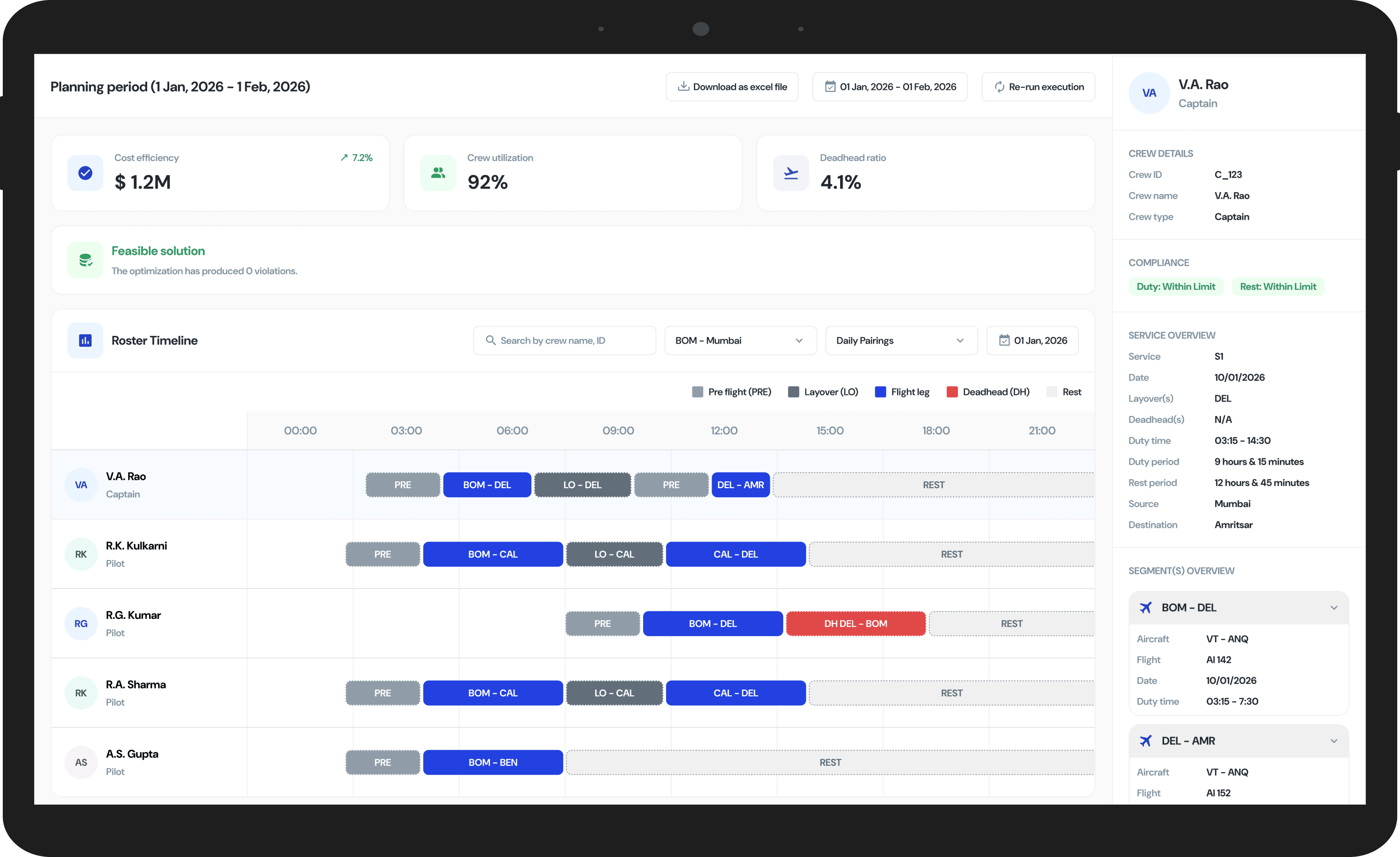
The optimizer generates crew group assignments (composed of individual crew members) mapped against duty periods. A Gantt chart best represents this structure because it clearly visualizes time-based overlaps, sequencing, and allocation across multiple entities in a single view.


// 02 infeasible solution
surfacing violations
An infeasible solution occurs when user-defined constraints can’t be satisfied. I surfaced this with each card communicating the violation.
// 03 suggestions to fix
fixing violations
I designed an intelligent suggestions card that offers multiple ways to resolve errors globally, each with clear trade-offs. An apply & re-run button ensures the user doesn't have to do the manual work of fixing the constraints themselves.

// planning view
putting it together
The execution page brings together the optimizer output, violations summary, suggestions to fix, and the Gantt chart with appropriate filters in a single cohesive view. Crew member details were provided by a left panel to ensure the main timeline context stays in view.

key impact
As a V1 release, post-launch usage data wasn't available - but the suggestions + re-run flow was greenlit for the next development sprint, validating the direction with the product team.
For a scheduling scenario with many crew members, this shift means the burden of the task changes entirely: from building a schedule from scratch, to reviewing and approving one.
BosonQ Psi's optimizer built on advanced QIEO algorithms flips this: it generates the best possible assignment under complex constraints automatically & much faster, reducing planner intervention to exception handling rather than routine decision-making.
Legacy crew scheduling interfaces put the burden on planners - manually assigning crew, mentally tracking constraints, and iterating through conflicts under time pressure.
I recommend Amartya Banerjee without reservation for roles in UX design, product design, or human centered computing. He would be a tremendous asset to any team seeking a designer who combines strong visual skills with system-level thinking and collaborative impact.
-Dr. Roopesh Mathur (VP Product Management BQP)
key learnings
I learned that in complex technical domains, the designer's first job is to become literate enough to ask the right questions. The early sketch sessions with developers were more than wireframing. They were me building enough domain understanding to know what the UI even needed to do.